Algo-Model
MetaboGuard Prevention Model Specification
Clinical purpose
MetaboGuard is a research system for preventive monitoring. It identifies unusual metabolic profiles and produces reusable patient representations for future longitudinal validation.
It is not a diagnostic system. A warning means “this profile differs from the reference and may warrant clinician review,” not “this patient has or will develop cancer/diabetes.”
Intended users
- clinical researchers;
- data scientists working with approved health datasets;
- clinicians reviewing research outputs in context;
- patients only through clinician-mediated explanations.
No autonomous patient-facing alerts are permitted in the current version.
Model layers
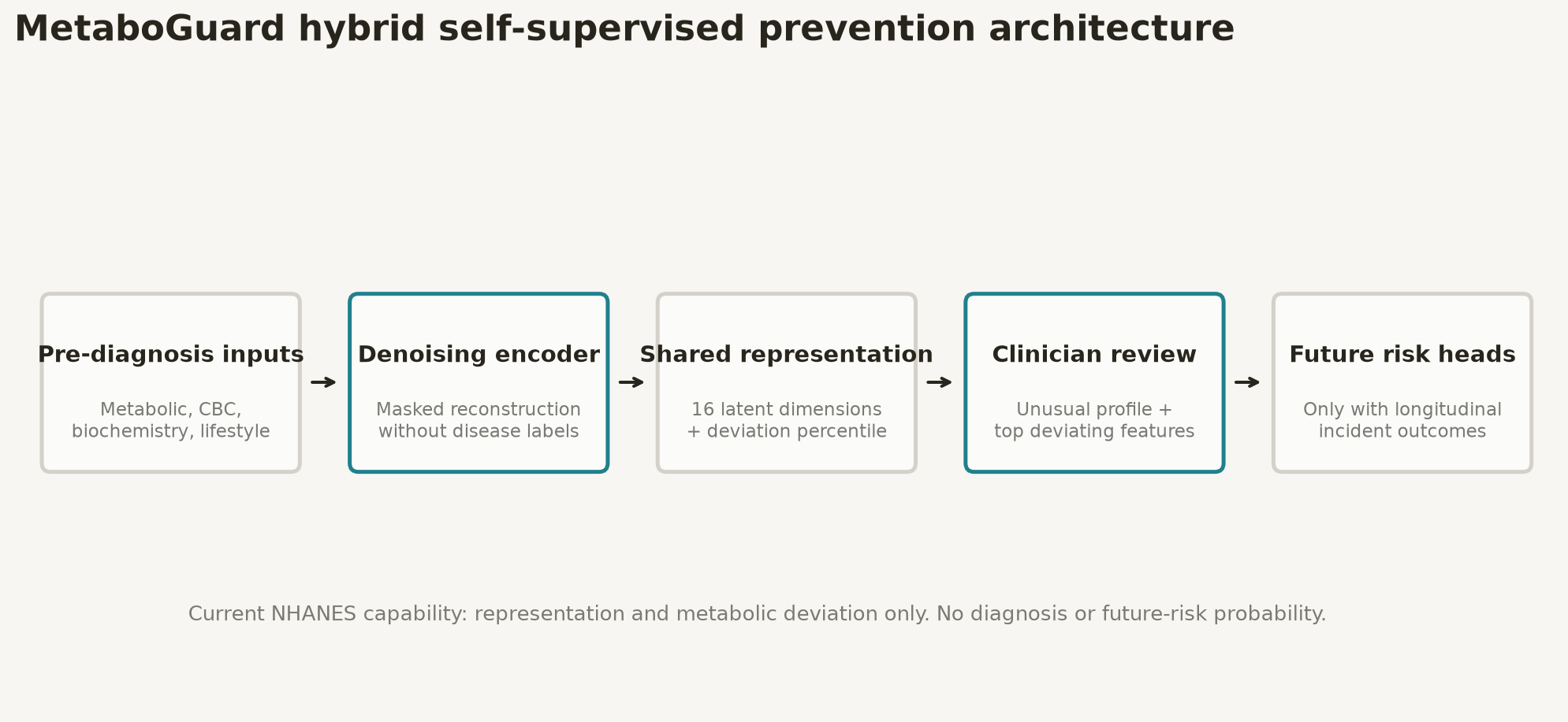
Layer 1: self-supervised encoder
Input:
- demographics;
- body measurements;
- glucose/HbA1c/insulin/C-peptide;
- lipids and inflammation;
- CBC and routine biochemistry;
- smoking, alcohol and weight change.
Training:
- no cancer or diabetes labels;
- 15% random feature masking;
- Gaussian corruption;
- reconstruction objective;
- robust scaling and missingness indicators;
- adult NHANES records.
Output:
- 16-dimensional latent representation;
- reconstruction error;
- latent-distance score;
- combined metabolic-deviation score;
- reference percentile;
- top five deviating source features.
Layer 2: anomaly/deviation warning
The warning score combines:
- 70% robust-standardised reconstruction error;
- 30% robust-standardised latent distance.
Reference percentiles are empirical percentiles from the training cohort.
Suggested research-only bands:
| Percentile | Label | Interpretation |
|---|---|---|
| <90 | Within reference range | No model warning; not evidence disease is absent |
| 90-95 | Mild deviation | Consider data quality and routine review |
| 95-99 | Elevated deviation | Clinician-reviewed follow-up research |
| ≥99 | High deviation | Strongly unusual profile; still not diagnostic |
These bands are not clinically validated thresholds.
Layer 3: post-hoc association heads
Labels are introduced only after encoder training to assess representation content.
Current heads:
- any-cancer prevalence;
- Type 2 diabetes proxy;
- Type 1 proxy, research-only.
No current head is a future-development model because NHANES lacks patient-level longitudinal outcomes.
Layer 4: future longitudinal risk heads
When longitudinal data are available:
- choose prediction times before diagnosis;
- censor all post-index measurements;
- evaluate 1-, 3- and 5-year horizons;
- enable a horizon only with at least 50 events and 50 eligible non-events;
- validate by site and calendar period;
- calibrate probabilities separately for each horizon.
The user-selected “custom horizon based on available data” is implemented as event-count-based horizon eligibility rather than a fixed universal window.
Dataset governance
Prevention feature allowlist
Only measurements plausibly available before diagnosis are allowed.
Denylist
Prohibited:
- cancer diagnosis labels as encoder inputs;
- tumour site, stage, grade or histology;
- treatment response;
- survival/progression events and times;
- post-diagnosis pathology;
- diabetes diagnosis-age or insulin-use variables when evaluating diabetes development;
- genetics without project approval.
Dataset capability states
| State | Allowed outputs |
|---|---|
| Cross-sectional only | representation, deviation score, association checks |
| Repeated measurements without outcomes | trajectory embeddings, no disease risk |
| Longitudinal with incident outcomes | eligible multi-horizon risk heads |
| Post-diagnosis cancer cohort | prognosis/context research only |
Cancer scope
The cancer head is pan-cancer by default. Cancer-site-specific heads require enough incident cases at the selected horizon. Sites are not pooled blindly if their biology, screening pathways or treatment histories materially differ.
TCGA can inform cancer heterogeneity and prognosis, but it cannot validate pre-diagnosis metabolic warnings.
Diabetes scope
Type 2
Metabolic early-warning research is feasible with glucose, HbA1c, insulin, adiposity, lipids and longitudinal outcomes.
Type 1
Current output is research-only. Patient-facing Type 1 warnings require:
- GAD, IA-2, ZnT8 and/or insulin autoantibodies;
- C-peptide;
- family history;
- longitudinal glucose/HbA1c;
- approved genetics where permitted.
The current proxy must not be described as Type 1 diagnosis or development risk.
Evaluation
Representation:
- reconstruction loss;
- latent stability;
- missingness sensitivity;
- subgroup distribution checks.
Deviation score:
- repeat-measurement consistency;
- association with future outcomes only in longitudinal cohorts;
- false-alert burden;
- subgroup alert-rate parity.
Risk heads:
- AUROC;
- AUPRC and lift over prevalence;
- Brier score;
- calibration intercept/slope;
- decision curves;
- temporal and external validation;
- event counts and confidence intervals.
Current evidence status
The current MetaboGuard-SSL artifact demonstrates technical feasibility:
- 50,000 unlabelled training rows;
- 25 raw features;
- 16 latent dimensions;
- NumPy-only inference;
- feature-level reconstruction explanations.
Cross-sectional association checks must not be interpreted as future development performance.
Future-risk layer (simulation only)
A future-risk layer exists in code and is disabled for real patients. It is documented in
docs/FUTURE_RISK_PROTOCOL.md (endpoints, splits, gates), docs/LONGITUDINAL_SCHEMA.md (data
contract) and docs/FUTURE_RISK_EVALUATION.md (metrics and controls).
- Data: synthetic longitudinal cohorts only. Preferred generator is official Synthea v3.3.0 (Apache-2.0; methodology DOI 10.1093/jamia/ocx079; validity limits DOI 10.1186/s12911-019-0793-0). A declared-enrichment in-repo simulator is the alternative, with sampling strata and weights retained. Ordinary-incidence and enriched metrics are never pooled.
- Outputs: cause-specific cumulative incidence at 1, 3 and 5 years, raw and calibrated, with death handled as a competing event.
- Gating: each horizon needs ≥50 events and ≥50 non-events among eligible patients or it abstains. Type 1 diabetes is never enabled. Site-specific cancer heads stay disabled below the same gate.
- Selection: calibration-first (smallest |calibration slope − 1|, ties by AUROC). A temporal sequence model is admissible only if reversing visit order degrades AUROC by ≥0.02; otherwise it is marked experimental and rejected, and a calibrated baseline is used.
- Access:
POST /api/v1/simulation/future-risk-scorerequires an explicitsimulation_mode=trueand a simulation-only artefact.POST /api/v1/prevention-future-riskreturns HTTP 409 and will continue to until an approved real cohort exists.
No synthetic metric from this layer is evidence of clinical performance, calibration transfer or early detection.
A future-risk layer exists in code and is disabled for real patients. It is documented in
docs/FUTURE_RISK_PROTOCOL.md (endpoints, splits, gates), docs/LONGITUDINAL_SCHEMA.md (data
contract) and docs/FUTURE_RISK_EVALUATION.md (metrics and controls).
- Data: synthetic longitudinal cohorts only. Preferred generator is official Synthea v3.3.0 (Apache-2.0; methodology DOI 10.1093/jamia/ocx079; validity limits DOI 10.1186/s12911-019-0793-0). A declared-enrichment in-repo simulator is the alternative, with sampling strata and weights retained. Ordinary-incidence and enriched metrics are never pooled.
- Outputs: cause-specific cumulative incidence at 1, 3 and 5 years, raw and calibrated, with death handled as a competing event.
- Gating: each horizon needs ≥50 events and ≥50 non-events among eligible patients or it abstains. Type 1 diabetes is never enabled. Site-specific cancer heads stay disabled below the same gate.
- Selection: calibration-first (smallest |calibration slope − 1|, ties by AUROC). A temporal sequence model is admissible only if reversing visit order degrades AUROC by ≥0.02; otherwise it is marked experimental and rejected, and a calibrated baseline is used.
- Access:
POST /api/v1/simulation/future-risk-scorerequires an explicitsimulation_mode=trueand a simulation-only artefact.POST /api/v1/prevention-future-riskreturns HTTP 409 and will continue to until an approved real cohort exists.
No synthetic metric from this layer is evidence of clinical performance, calibration transfer or early detection.
A future-risk layer exists in code and is disabled for real patients. It is documented in
docs/FUTURE_RISK_PROTOCOL.md (endpoints, splits, gates), docs/LONGITUDINAL_SCHEMA.md (data
contract) and docs/FUTURE_RISK_EVALUATION.md (metrics and controls).
- Data: synthetic longitudinal cohorts only. Preferred generator is official Synthea v3.3.0 (Apache-2.0; methodology DOI 10.1093/jamia/ocx079; validity limits DOI 10.1186/s12911-019-0793-0). A declared-enrichment in-repo simulator is the alternative, with sampling strata and weights retained. Ordinary-incidence and enriched metrics are never pooled.
- Outputs: cause-specific cumulative incidence at 1, 3 and 5 years, raw and calibrated, with death handled as a competing event.
- Gating: each horizon needs ≥50 events and ≥50 non-events among eligible patients or it abstains. Type 1 diabetes is never enabled. Site-specific cancer heads stay disabled below the same gate.
- Selection: calibration-first (smallest |calibration slope − 1|, ties by AUROC). A temporal sequence model is admissible only if reversing visit order degrades AUROC by ≥0.02; otherwise it is marked experimental and rejected, and a calibrated baseline is used.
- Access:
POST /api/v1/simulation/future-risk-scorerequires an explicitsimulation_mode=trueand a simulation-only artefact.POST /api/v1/prevention-future-riskreturns HTTP 409 and will continue to until an approved real cohort exists.
No synthetic metric from this layer is evidence of clinical performance, calibration transfer or early detection.
Release policy
An artifact may be shared for representation benchmarking if its model card states that it is non-diagnostic and cross-sectional.
A disease-risk artifact may not be published until:
- the endpoint is independently verified;
- longitudinal index/outcome timing is defined;
- event thresholds are met;
- leakage audits pass;
- temporal/external validation is complete;
- Type 1 biomarker/genetic governance is approved where applicable.